What Were the Roles in the Family for Plateau Indians
Introduction
American Indians of the western range refers to American Indians who reside in a region of the western U.S. bordered on the west by the Sierra and Cascade mountains and on the east by the Rocky Mountains (Woodhead, 1995). The western range includes the Columbia Plateau and Keen Bowl cultural and physiographic areas.
This fact sheet briefly describes early on cultural attributes unique to the ethnic people of these areas. Professionals working on reservations are encouraged to acquire as much as possible about private reservations and tribes with respect to origin, history and culture.
Early Civilization and Lifestyle
Much of the knowledge nigh early ethnic cultures stems from speculative reconstructions by Euro-American explorers subsequently their initial contact with ethnic peoples.
Early American Indians of the western range were a survivalist culture, which necessitated a semi-nomadic lifestyle. That is, during the wintertime they resided in permanent lodges and consumed foods they prepared and stored for the common cold winter months. During the remainder of the year, they moved among established camps in rhythm with the change of seasons to hunt and gather food (Hunn, Turner & French, 1998).
In contempo geological terms, the Great Basin is primarily high desert, open barren land with alkaline soils. Although the Neat Bowl receives little precipitation, its bowl-and-range topography provided indigenous peoples with small game also as nuts and seeds from the tree-lined mountain ridges. Its lowland perennial streams and marshes provided diverse water fowl, such as ducks and mud hens, and eggs. Pocket-size game consisted of jack rabbits primarily with occasional deer and mount sheep. While northern Great Bowl Indians hunted mountain sheep in addition to elk and deer, central Great Basin Indians relied more heavily upon rabbit supplemented occasionally with whitetail deer.
In contrast, the Columbia Plateau further north featured a more varied environment ranging from coniferous forests to lush mountain meadows and bunch grasses. Its forests supplied elk and behave, while its plateau grasses provided rabbit, deer and antelope. Native plants provided an important nutrient staple for western range peoples. A diverseness of wild vegetables were consumed, including wild carrot, onion, dandelion and spinach.
Both Plateau and Smashing Bowl peoples relied heavily on roots of the camas found. They constructed tools to dig for roots, including wooden sticks, often with antler horns for handles. Columbia Plateau Indians harvested a large diverseness of wild berries, including huckleberry, chokecherry and strawberries while Great Bowl Indians harvested seeds and pine basics primarily.
Archaeological show, including artifacts such equally handmade hooks, nets and traps, suggests that the majority of early western range Indians relied heavily upon fish. Indians located farther upstream and inland who relied more upon rabbit, deer and elk traded animal skins and camas roots for salmon harvested and dried by tribes located closer to salmon runs (Boyd, 1998). Similarly, Great Basin Indians fished the rivers and terminus lakes of their rugged loftier desert homeland. In northern and fundamental Nevada, the rivers running through these lands originated as streams fed by snowfall cook from the surrounding Sierra Nevada. These include the Truckee, Carson, and Walker rivers. The people living along these rivers and terminus desert lakes relied upon various species of trout in add-on to big bodied sucker fish such as cui-ui.
Fish provided a diet staple for early Indians.
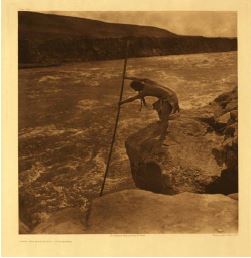
During the spring, summer and autumn Indians throughout the western range convened at major deltas and similar points along the Columbia River to bask bountiful fish harvests. Indians who attended these gatherings traded appurtenances, such every bit herbs, dried meats, animal skins, obsidian arrow heads, hand-made tools, woven baskets, shells and beads. The gatherings too provided a range of social opportunities, including gambling, games, dancing, courtship, matrimony and ceremonies.
Early Housing
Early Indians throughout the western range lived and travelled as bands. Typically these bands consisted of i to a few families related by union, or kin-cliques.
Accounts of early explorers described the winter lodges of Not bad Basin Indians, or wiki-ups, as hemispherical-shaped lodges. To build the support frame, they lashed together native willow saplings, leaving a hole at the top for smoke and an opening at the east side for an entrance. They covered the frame with a thick thatch of dried piňon needles and sometimes covered the thatch with earth equally well every bit sealed the bottom of the construction with globe and mud. Summertime homes near angling areas included shade houses primarily and were constructed of willow boughs and sage castor (Curtis, 1911).
Native plants were used to construct homes.
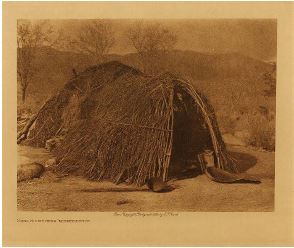
Many early on Columbia Plateau Indians lived in permanent longhouses which were rectangular-shaped, supported with lodgepole pine frames and covered with mats woven from tule bulrush that grew in riparian areas. The tule reeds provided insulation during the wintertime and immune the house to breath in the summer. Large numbers of families, typically related past marriage, shared these lodges with each family having a designated expanse for fire, cooking and sleeping.
Smaller, conical shaped structures of the same materials were also constructed to house nuclear families. After adoption of the horse, many Plateau Indians constructed their lodgings from animal skins and later sail, instead of tule mats, which provided a lighter, more hands transportable lodge.
Basket-maker Civilisation
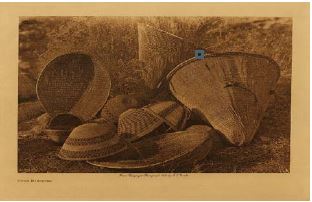
Anthropologists refer to the early Indians of the western range as a handbasket maker culture. Baskets were essential tools used to harvest and process plants and seeds as well equally to transport medicine, food and personal belongings. Western range Indians wove baskets from bachelor native plants. In the northern Great Basin, Indians fabricated their baskets from willows that grew forth the riverbanks, gathering them start in the fall and ending in the spring. They sealed willow baskets with the pine tar from the local piňon trees in lodge to use the baskets to conduct and store water.
For the Plateau Indians, materials for handbasket weaving involved a multifariousness of native plants, including bear grass, cedar root, cedar tree bark, Indian corn husks and hemp. Columbia Plateau Indians invested significant time during the winter producing hemp cord which they used in the construction of tule mats for housing, bedding and flooring in add-on to the construction of other baskets, numberless and hats (Miller, 1998). Soft bags, referred to every bit 'sally bags', were constructed to collect roots and likely as objects of personal adornment. Similarly, Columbia Plateau Indian women wove and wore soft, notwithstanding structured, basket hats which served every bit protection from common cold, wind, grit, rain, and the caput straps used to behave burdens on their backs, such equally cradle boards. Basket hats probable served as objects of personal beautification every bit well (Schlick, 1994). The heart region of the Columbia River in particular features some of the best examples of Indian basketry in North America.
Baskets were essential survival tools.
Linguistic communication
The bulk of the early Indian peoples within the Columbia Plateau region spoke a dialect of the Sahaptin linguistic communication family. Speakers of the Salish language family settled to the n and east of Sahaptin speakers in modernistic-day Canada (Kinkade, et al., 1998). The Bang-up Bowl Indians spoke dialects of the Uto-Aztecan linguistic communication family. This rather large linguistic communication family includes languages notwithstanding spoken by millions of descendents of the ancient Aztec civilization who live in cardinal United mexican states and in parts of Republic of guatemala, and Key America (Miller, 1986).
As is the case with many American Indian tribes, native language is disappearing with fewer tribal members, mainly elders, able to speak their native natural language. Over the by several decades, tribal governments and schools in the Plateau and Great Basin regions have made concerted efforts to rekindle an interest in and pride in cultural heritage, with a focus on native languages. Several reservations have established native language programs either every bit role of their school curriculum or equally extracurricular learning programs.
Influence of the Horse
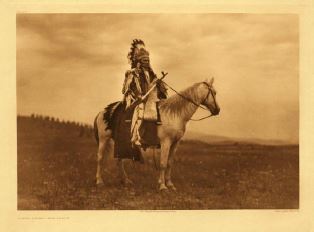
Some anthropologists attribute much of the meaning changes to Columbia Plateau Indian culture that occurred betwixt 1600 and 1750 to the influence of the horse rather than interaction with non-Indians. Plateau Indians were able to travel greater distances to hunt bison cooperatively with Plain tribes, oftentimes adopting the customs and dress of Indians with whom they intermingled. Due to its harsh climate and environment, Great Basin Indians adopted the horse insufficiently after, during the 18th century. However, once they adopted the horse, Great Bowl Indians quickly expanded their seasonal hunting patterns and merchandise activities with tribes far away from their ancestral grounds (Shimkin, 1986). The horse was such a powerful influence on Indians that the Columbia Plateau Indians, in particular, became known equally a horse culture. Meaning and sincere respect for the equus caballus remains apparent throughout the western range Indian culture today. Many gimmicky reservation events and celebrations continue to feature horseback-riding sports and activities, including Indian ceremonial costumes and regalia designed especially for horse and rider.
Columbia Plateau tribes became good horse breeders.
Summary
This fact canvas provides a brief overview of the early on culture unique to the American Indians of the western range, the Columbia Plateau and Great Basin. The purpose of this fact sheet is to increase sensation and appreciation of cultural attributes that distinguish American Indians in this geographic region. Professionals working on reservations are encouraged to learn every bit much every bit possible near private reservations and tribes with respect to origin, history and culture.
References
Curtis, E.Southward. (1911). The North American Indian. Northwestern University Library. Retrieved May 9, 2008 from The North American Indian
Hunn, E.Southward., Turner, N. J., & French, D. H. (1998). Ethnobiology and Subsistence, in Deward East. Walker, Jr. (Volume Ed.), Handbook of North American Indians: Plateau (Vol. 12), pp. 525-545. Washington, DC: Smithsonian Institution.
Kinkade, M.D., Elmendorf, W.West., Rigsby, B., & Aoki, H. (1998). Languages, in Deward E. Walker, Jr. (Book Ed.), Handbook of North American Indians: Plateau (Vol. 12), pp. 49-72. Washington, DC: Smithsonian Institution.
Miller, J. (1998). Eye Columbia River Salishans, in Deward E. Walker, Jr. (Volume Ed.), Handbook of North American Indians: Plateau (Vol. 12), pp. 253-270. Washington, DC: Smithsonian Institution.
Miller, Westward.R. (1986). Numic Languages, in Westward. Fifty. D'Azevedo (Book Ed.), Handbook of North American Indians: Bully Basin (Vol. eleven), pp. 98-106. Washington, DC: Smithsonian Institution.
Schlick, M.D. (1994). Columbia River Basketry: Gift of the Ancestors, Gift of the Globe. Seattle, WA: Academy of Washington Printing.
Shimkin, D.B. (1986). Introduction of the Horse, in W. Fifty. D'Azevedo (Volume Ed.), Handbook of North American Indians: Corking Basin (Vol. 11), pp. 517-524. Washington, DC: Smithsonian Institution.
Woodhead, H. (1995). Indians of the Western Range. Richmond, VA: Time-Life Books.
gipsonhambethinde.blogspot.com
Source: https://extension.unr.edu/publication.aspx?PubID=2208
0 Response to "What Were the Roles in the Family for Plateau Indians"
Post a Comment